
The Tortoise Wins Twice: What SGA’s Back-to-Back MVP Confirms About Building Cultures That Last

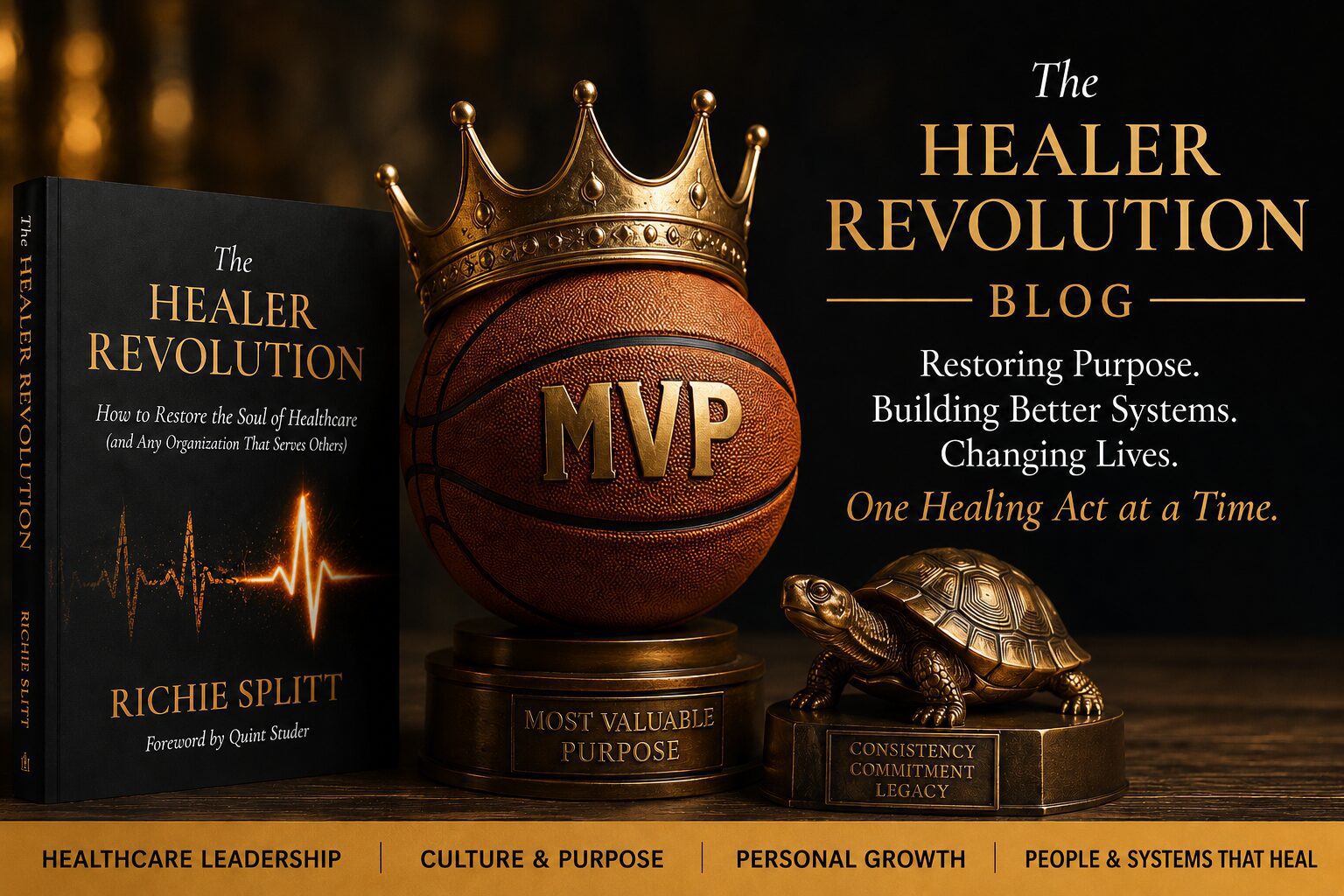
On the second MVP, the tortoise statue, and what healthcare leaders should be learning from Oklahoma City.
Yesterday, the NBA announced that Shai Gilgeous-Alexander (SGA) won the 2025-26 Most Valuable
Player award. He received 83 of 100 first-place votes, with Nikola Jokić finishing second and Victor
Wembanyama third. It’s his second consecutive MVP, making him the 14th player in NBA history to
win back-to-back MVPs, and the fifth guard to do it.
The numbers are remarkable. He averaged 31.1 points per game and did not score below 20 points
in any of his 68 games this season. By any individual measure, this was a transcendent year.
But here’s what I keep coming back to as a healthcare leader watching from across the parking lot
at Paycom Center: the most important sentence in any of this didn’t come from SGA yesterday. It
came last June.
Days after Oklahoma City won its first NBA championship in 2025, SGA stood in front of his
teammates with tears in his eyes and said, “This award is your award too.” He’d had custom gifts
made for each of them — embroidered jackets bearing the team’s 68-14 championship-season
record, watches inside the gift baskets — turning his individual achievement into a shared one.
A year later, he is the MVP again. And the culture is still doing the same work.
The Tortoise and the Hare
I wrote about the OKC Thunder in Chapter 22 of The Healer Revolution, framed around a story SGA
himself has told publicly: when he first arrived in Oklahoma City, GM Sam Presti gave him a copy of
The Tortoise and the Hare. The meaning was patience, process, and slow growth paying off. Presti
was using the fable as a metaphor for the Thunder’s rebuild — don’t chase shortcuts, stay steady,
and trust the long path even when progress looks frustrating. SGA admits he didn’t think he needed
the lesson. The next few years for him and the team were, in his words, “very, very rough.”
After some time and a lot of hard work and harder lessons, the team started to win. When they
captured the championship in 2025, Presti gave SGA a tortoise statue. A “we stayed the course”
symbol, or as SGA himself described it, a very Presti-style way of saying I told you so. The book
marked the beginning of the lesson. The statue marked the proof that the lesson worked.
Now SGA has two MVP trophies. And the tortoise is still there.
Look at what the tortoise can see from the shelf where it sits. Last season: 68 wins, 14 losses. This
season: 64 wins, 18 losses. A near-mirror with the edges slightly softer — four games of adversity
priced into the year.
The tortoise doesn’t run the same race twice. The terrain changes. The weather changes. The hare
changes shape from season to season. What the tortoise does is keep moving forward at a pace it
can sustain — and that consistency, over time, looks something like 68-14 last year and 64-18 this
year. A team that posted identical records two years in a row would be running a script. A team that
posted near-identical records through two genuinely different seasons is running on something
deeper than circumstance.
I find this image important because healthcare leaders are surrounded, daily, by pressure to be the
hare. Fill nursing vacancies this month. Improve satisfaction scores next week. Cycle leaders if
numbers don’t move quickly. Healthcare has been trained to run like the hare.
The Thunder spent five years being the tortoise while critics demanded they run like hares. They
lost. They got embarrassed. They suffered a 73-point loss to Memphis and head coach Mark
Daigneault gathered the team afterward and asked: what can we learn? They were patient through
losses that would have triggered significant changes, if not firings, in most organizations today.
Then they won. And then they won the MVP. And then they won the MVP again. And along the
way, they won the city.
Three Things SGA’s Second MVP Confirms
- Character compounds — when the organization makes it the question.
Sam Presti’s revolution wasn’t built on acquiring stars. It was built on a single character question
applied to every roster decision: does this person make us less than the sum of our parts, or more?
That question doesn’t sound revolutionary on paper. But it changes everything when an
organization actually means it — when it survives the late-round draft pick, the off-season trade
negotiation, the front-office disagreement about a player’s measurables. The Thunder kept asking
it. Five years later, they had a championship roster. Six years later, they have a back-to-back MVP
whose acceptance language remains “this is your award too.”
Healthcare has every reason to think differently about character. Most leaders I know already do.
But the question often gets crowded out by everything else demanding attention in a hiring
decision — credentialing requirements, regulatory pressures, immediate staffing needs,
productivity metrics. None of those is wrong. They’re just incomplete.
The Thunder didn’t ignore talent. They asked one additional question — and they asked it
consistently for years. The lesson for healthcare isn’t that we’re hiring wrong. It’s that one persistent
question, asked alongside everything else we already evaluate, that compounds into a different kind
of organization over time.
- Recognition that names specifics changes behavior.
SGA’s gift baskets weren’t powerful because of the dollar value. They were powerful because each
one was personalized to what that teammate had actually done that year. The specificity is what
made the gesture land. “Good job” is forgettable. “I saw you stay late to comfort that patient’s family”
is unforgettable.
Healthcare leaders who want to start a recognition revolution don’t need a budget. They need to
start naming what they actually see.
- Psychological safety produces championship play.
After the 73-point loss to Memphis in 2025, Coach Daigneault didn’t deflect or assign blame. He
asked the team what they could learn. Two weeks later, they beat Memphis. The difference wasn’t
new plays — it was the trust built by acknowledging failure honestly and in public.
In healthcare, the equivalent moment happens every time a nurse senses a patient isn’t ready for
discharge but feels uncertain about pushing back on a physician’s pressure. Whether she speaks up
depends entirely on whether the culture has consistently demonstrated — not stated, demonstrated
— that her voice is welcome. That kind of culture is the difference between adverse events and
learning moments.
What Yesterday’s Announcement Means
SGA’s second MVP doesn’t prove that talent wins. We already knew that. What it proves is that a
culture that places team above self can sustain elite individual performance year after year — even with
the player at the center of that culture being publicly recognized as the league’s best.
In a world that constantly tells our best people to maximize their personal brand, his answer has
remained the same since he received the tortoise: this is your award too.
Healthcare needs more leaders willing to give the award away. Not because individual excellence
doesn’t matter — it does — but because individual excellence only sustains when it elevates
collective achievement.
The blueprint is in Oklahoma City. The proof is now a back-to-back MVP. The remaining question is
whether healthcare has the courage to build the same way.
Somewhere in this state, a tortoise statue sits next to two MVP trophies and a championship ring.
Whether a second ring joins them this June or doesn’t, the lesson holds. The race goes to those who
refuse to stop moving forward.
Chapter 22 of The Healer Revolution explores in greater depth what the Thunder’s championship culture
teaches healthcare about character-first hiring, psychological safety, community connection, and
patient development over quick fixes. The book is available now through Amazon and at
healerrevolution.org.