
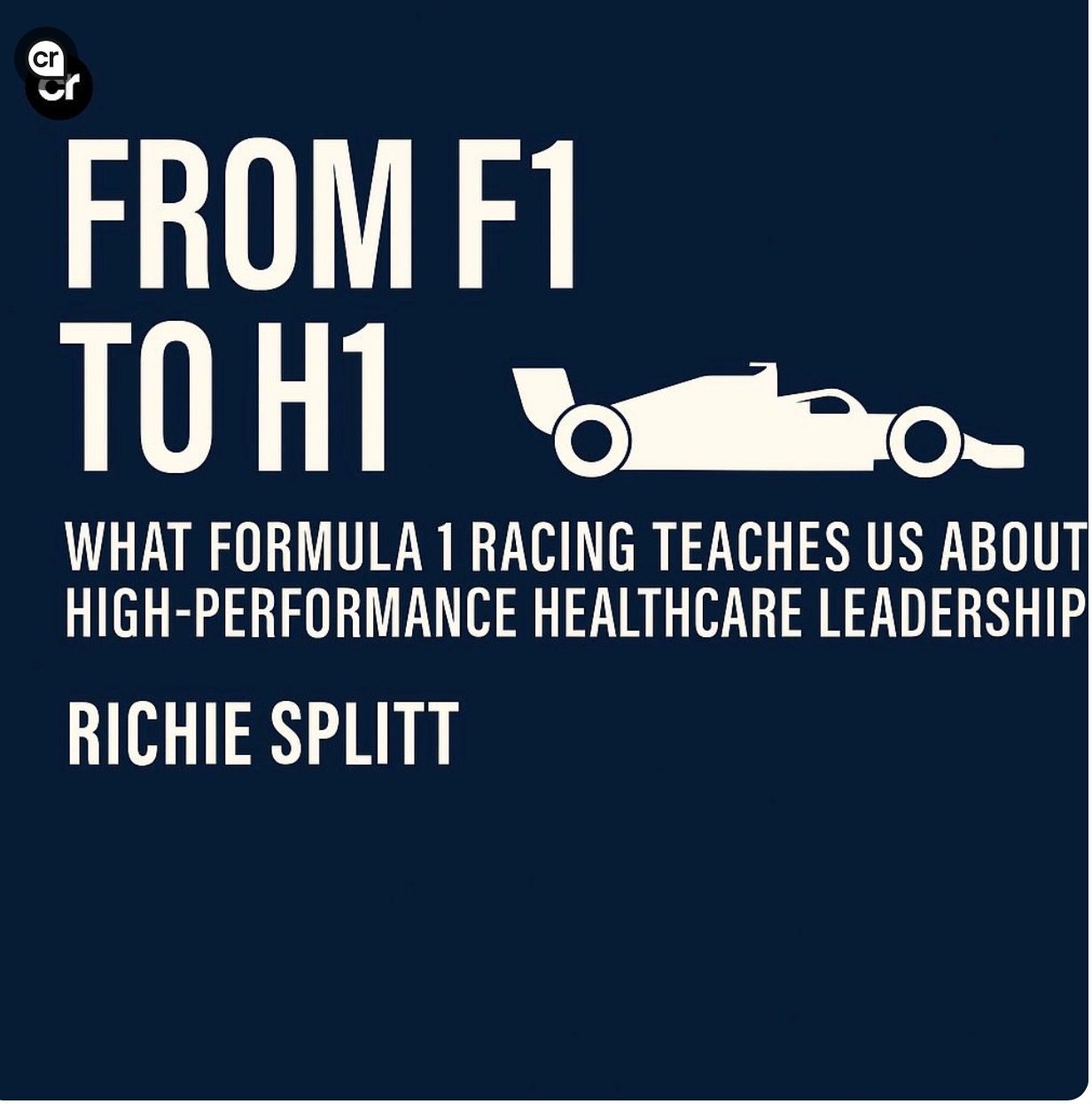
From F1 to H1: What Formula 1 Racing Teaches Us About High-Performance Healthcare Leadership (Part 1 of 2)
(July 2025)
When the Checkered Flag Meets the Stethoscope
Last weekend, I walked out of the theater after watching “F1” starring Brad Pitt, both impressed by the production’s authenticity and inspired by something unexpected—the leadership principles woven throughout the storyline. Even if you’re not a Formula 1 enthusiast or Brad Pitt fan, I’d encourage you to see this film through a leadership lens. The storytelling brilliantly illustrates team dynamics, mentorship, and decision-making under pressure in ways that transcend racing. As someone who’s spent decades in healthcare leadership, I couldn’t help but see striking parallels between the high-octane world of Formula 1 racing and the life-and-death decisions we make in healthcare every day.
The film’s portrayal of veteran driver Sonny Hayes mentoring rookie Joshua Pearce, the precision of pit crew teamwork, and the strategic adaptability under pressure reminded me why I’m passionate about what I call the journey “From F1 to H1″—transforming Formula 1’s principles of speed, precision, and teamwork into “H1 culture,” the healer’s equivalent pursuit of excellence through unified purpose, compassionate care, and flawless execution in service of healing others.
The Pit Stop Principle: Precision Under Pressure
In F1, a pit stop can make or break a race. The film beautifully captures those heart-stopping moments where a crew of specialists must execute a tire change in under three seconds, each member knowing their role with absolute precision. One miscommunication, one hesitation, and the race is lost.
Sound familiar?
I’ve witnessed this same principle in action during a code blue in the ICU. The attending physician leads with calm authority, the nurse administers medications with practiced precision, respiratory therapy manages the airway, and the pharmacist calculates dosages in real-time. Like that F1 pit crew, there’s no room for ego — only purpose, trust, and flawless execution.
Healthcare Application: Create “pit stop protocols” for critical situations. Regular drills, clear role definitions, and post-event debriefs can transform chaotic emergencies into choreographed excellence.Mentorship as a Competitive Advantage
The relationship between Sonny Hayes and Joshua Pearce evolves from rivalry to mutual respect, ultimately becoming the team’s greatest strength. Sonny’s willingness to share decades of experience while respecting Joshua’s fresh perspective creates a dynamic that elevates both drivers.
In healthcare, we often underestimate the power of structured mentorship. I’ve seen seasoned nurses guide new graduates through their first year, sharing not just clinical knowledge, but the emotional intelligence needed to navigate family dynamics, ethical dilemmas, and the weight of responsibility that comes with healing others.
Healthcare Application: Implement formal mentorship programs that pair experienced clinicians with emerging talent. Create spaces for reverse mentoring where younger team members share fresh perspectives on technology and patient engagement.
Strategic Adaptability: The “Plan C” Mindset
Throughout the film, we see teams pivot strategies mid-race, adjusting to weather changes, mechanical issues, or competitor moves. The best teams aren’t just prepared for Plan A or Plan B; they’re ready for Plan C, D, and beyond.
This resonates deeply with my experience in healthcare administration. During the pandemic, we watched health systems worldwide demonstrate this adaptability—converting conference rooms into ICUs, implementing telehealth programs overnight, and redesigning workflows to protect both patients and staff.
Healthcare Application: Build adaptability into your organizational DNA. Regular scenario planning, cross-training initiatives, and a culture that celebrates intelligent risk-taking will prepare your team for whatever challenges emerge.
The Unity of Purpose: From Competition to Collaboration
What struck me most about the film was the transformation of APXGP from a fractured team into a unified force. When team members moved beyond individual ambitions to embrace collective purpose, their performance soared.
This mirrors what I’ve observed in high-performing healthcare organizations. When physicians, nurses, administrators, and support staff align around patient outcomes rather than departmental silos, magic happens. Quality scores improve, satisfaction increases, and burnout decreases.
Healthcare Application: Establish shared metrics that unite all departments around patient experience and outcomes. Create opportunities for interdisciplinary collaboration that break down traditional hierarchies.
Building Your H1 Culture
The principles demonstrated in F1 — precision under pressure, mentorship, adaptability, and unity of purpose — aren’t just entertainment; they’re a blueprint for excellence in leadership.
As I continue developing my manuscript on healer cultures, I’m constantly reminded that inspiration comes from unexpected places. Whether it’s a Formula 1 pit crew or a trauma team, the fundamentals of high-performance leadership remain constant: clear communication, shared purpose, mutual respect, and a resolute commitment to excellence.
What’s your take? Have you observed similar parallels between high-performance sports and healthcare? I’d love to hear about moments when your team operated with F1-level precision and unity.
Coming up in Part 2: I’ll explore how to sustain this level of performance through what has been described as “Flow” — the sustainable engine that powers exceptional healer cultures long-term.
As a healthcare leader who finds inspiration in sports, film, and diverse business models, I believe our greatest innovations come from looking beyond traditional healthcare paradigms. Sometimes the best leadership lessons are found in the most unexpected places.
#HealthcareLeadership #TeamDynamics #HealerCulture #LeadershipDevelopment #PatientCare #HealthcareInnovation
[F1 to H1: Part 2 of 2]
F1 to H1 — Finding Your Flow: The Sustainable Engine of Healthcare Excellence (Part 2 of 2)
“It’s Like I’m Flying” – The Gateway to Sustainable Performance
In Part 1, we explored the leadership principles from “F1” that translate beautifully to healthcare. Today, I want to dive deeper into something Brad Pitt’s character Sonny Hayes describes while racing at 200+ mph: “It’s like I’m flying.”
That moment of transcendence — where the roar of engines fades, chaos recedes, and every action feels instinctive — isn’t just cinematic drama. It’s a perfect illustration of what psychologist Mihaly Csikszentmihalyi calls “Flow”: a state of complete immersion where peak performance meets deep fulfillment.
After decades in healthcare leadership, I’ve witnessed this phenomenon countless times. The surgeon who loses track of time during a complex procedure. The nurse who effortlessly manages multiple critical patients. The administrator who finds clarity amidst organizational chaos. These aren’t just “good days” — they’re glimpses of what’s possible when we understand and cultivate Flow as the sustainable engine found in a healer culture.
Deconstructing the Flow State: Beyond the Adrenaline Rush
Flow isn’t about adrenaline or high-pressure situations alone. It’s characterized by nine core components that create optimal experience:
Clear Goals: Knowing exactly what needs to be accomplished; Immediate Feedback: Real-time information enabling course corrections; Challenge-Skill Balance: Tasks that stretch abilities without overwhelming; Deep Concentration: Laser focus that blocks distractions Sense of Control: Confidence in navigating challenges; Loss of Self-Consciousness: Complete absorption in the task; Altered Time Perception: Time seeming to speed up or slow down; Intrinsic Motivation: The work itself becomes rewarding; Action-Awareness Merger: Seamless unity between doing and being
When I experience Flow or observe other professionals in Flow, I see these elements converge. The emergency physician managing a trauma case with clear protocols (goals), instant patient response (feedback), and skills perfectly matched to the challenge — they’re not just working; they’re flying.
Flow as Your Professional Growth Catalyst
For individual healers, Flow isn’t luxury, it’s a necessity. Here’s why:
Accelerated Skill Development: Flow’s challenge-skill balance drives continuous learning. Residents transform during their rotations when they find that sweet spot between competence and challenge. They’re not just completing tasks; they’re evolving as practitioners.
Renewed Sense of Purpose: Flow reconnects us with why we entered healthcare. Remember that moment when you knew this was your calling? Flow recreates that feeling regularly, combating the cynicism that can creep into demanding careers.
Built-in Burnout Prevention: When we’re fully absorbed in meaningful work, stress becomes manageable. The ICU nurse who finds Flow during a busy shift reports feeling energized rather than depleted — the work itself becomes restorative.
Enhanced Patient Care: Flow doesn’t just feel good; it delivers better outcomes. Clinicians in Flow demonstrate increased empathy, improved decision-making, and more effective communication with patients and families.
Collective Flow: When Teams Soar Together
Individual Flow is powerful, but collective Flow — when entire teams operate in harmonious synchronization — transforms organizations. Think about F1’s pit crew executing a flawless stop, or better yet, recall the last time you witnessed a team, your team, in perfect rhythm.
A physician friend of mine observed this recently during a complex cardiac procedure. The physician and his Cath Lab team moved with choreographed precision. Communication was minimal, but perfectly timed. Each team member anticipated needs before they were voiced. The patient’s outcome was exceptional, but equally important — the team felt energized rather than exhausted.
Conditions for Collective Flow:
- Shared Vision: Everyone understands the common goal
- Clear Communication: Information flows seamlessly
- Balanced Skill Sets: Complementary strengths create synergy
- Psychological Safety: Trust enables risk-taking and innovation
- Mutual Purpose: Individual success serves collective achievement
Practical Strategies for Cultivating Flow
As leaders, we can intentionally design environments that foster Flow:
- Design Meaningful Work Architecture: Structure roles with clear objectives, immediate feedback loops, and optimal challenge-skill balance. Rotate assignments to prevent stagnation while building competence.
- Minimize Flow Disruptors: Create “flow blocks” — protected time for deep work. Use visual signals (like colored badges) to indicate when staff are in focused mode. Batch administrative tasks to preserve clinical concentration.
- Foster Autonomy and Ownership: Empower teams to shape their approach to care delivery. When clinicians have input into protocols and processes, they feel greater control and engagement.
- Build Psychological Safety: Encourage open communication about errors and near-misses. When team members feel safe to take calculated risks and learn from mistakes, innovation flourishes.
- Invest in Continuous Learning: Provide opportunities for skill development that match growing expertise. Nothing kills Flow faster than tasks that are too easy or overwhelmingly difficult.
- Model Flow Leadership: Share your own Flow experiences. When leaders demonstrate passion for their work and describe moments of deep engagement, it permits others to seek similar experiences.
The Sustainable Future of Healing
Flow isn’t a productivity hack — it’s a fundamental shift in how we approach work. When we prioritize Flow, we create environments where:
- Clinicians thrive rather than survive
- Innovation emerges naturally from engaged teams
- Patient outcomes improve through enhanced focus and care
- Retention increases as work becomes intrinsically rewarding
- Organizations build resilience through collective strength
As I continue developing my manuscript on healer cultures, I’m convinced that Flow represents our path to sustainable excellence. It’s not about working harder or faster — it’s about creating conditions where the work itself becomes a source of energy and fulfillment.
The next time you witness a colleague “flying” through their work with effortless precision, recognize it for what it is: a glimpse of what’s possible when we align human potential with meaningful purpose.
Your Flow Journey Starts Now
Reflection Questions:
- When do you experience Flow in your role?
- What conditions enable or prevent Flow in your organization?
- How might you design one aspect of your work to better support Flow states?
Challenge: This week, identify one process or interaction where you can apply Flow principles. Start small, perhaps a patient conversation or team meeting, and notice the difference. For example:
- Redesigning Patient Rounds from what can feel rushed, fragmented, and stressful for both staff and patients into focused, meaningful conversations that energize caregivers and create genuine connections with patients and families.
- Transform Team Huddles from unfocused information dumps that drain energy into purposeful alignment sessions that build team cohesion, enhance communication, and create shared momentum for exceptional patient care.
As healthcare leaders, we have the opportunity to transform not just what we do, but how we experience doing it. Sometimes the most profound insights come from unexpected sources — like a Formula 1 movie that reminds us what it feels like to fly.
#HealthcareLeadership #Flow #HealerCulture #SustainablePerformance #TeamDynamics #PatientCare #LeadershipDevelopment #HealthcareInnovation #ProfessionalGrowth