
Common Sense at 250

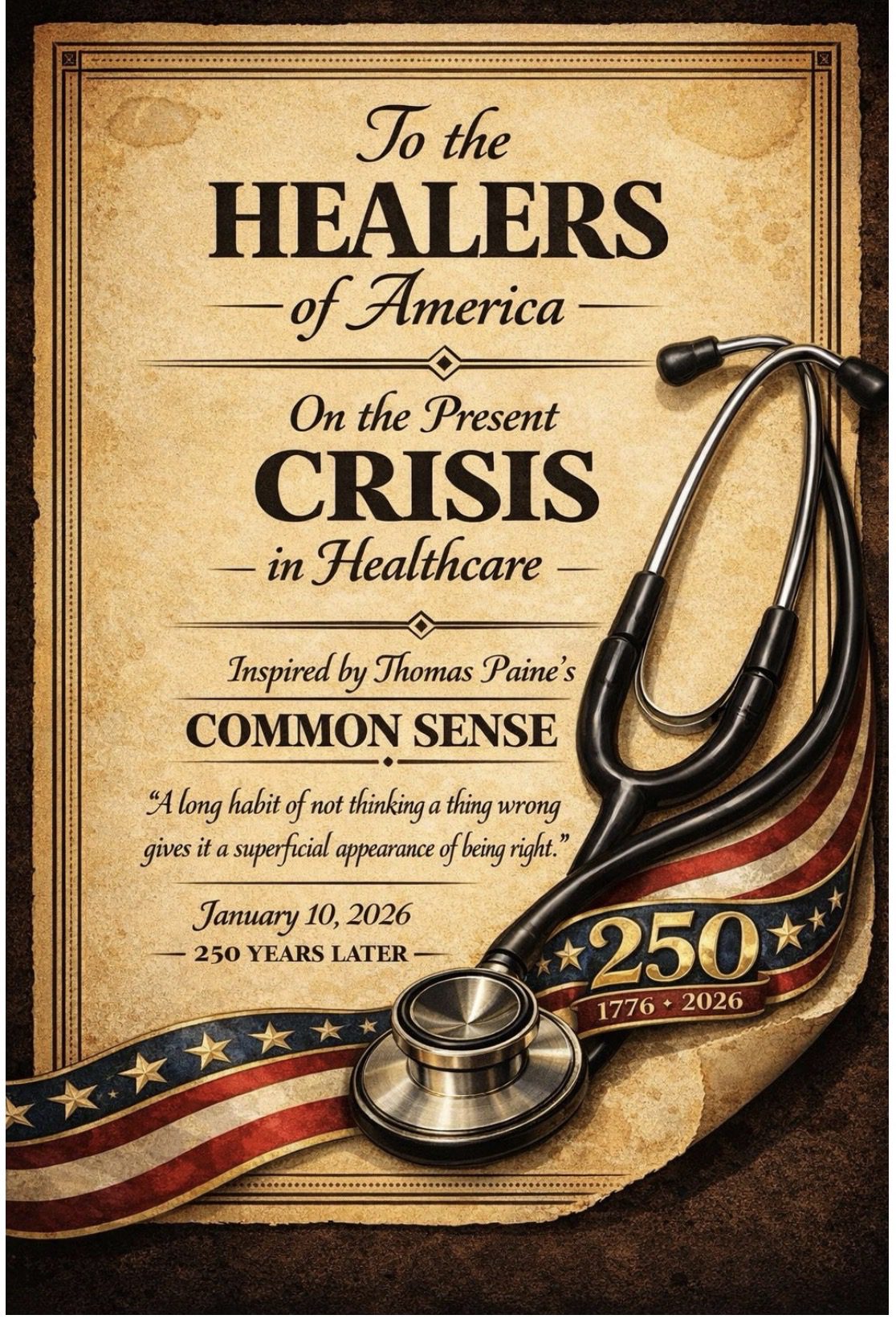
250 years ago today, a penniless pamphleteer changed the world with one dangerous idea:
Name what everyone feels, but no one dares say.
Thomas Paine’s Common Sense hit Philadelphia on January 10, 1776. It sold 120,000 copies in three months — in a nation of 2.5 million. Adjusted for population, that is 16 million copies in three months — twice the record Harry Potter set. No book in American history has come close.
Benjamin Franklin credited Paine with creating what we, the people, know today as the United States.
What made it so powerful? Not its anger. Anger was everywhere in the colonies.
Its power was clarity. Paine said plainly what colonists felt in their bones: the structure was failing them. Their suffering wasn’t inevitable — it was designed. And what is designed can be redesigned.
“A long habit of not thinking a thing wrong,” he wrote, “gives it a superficial appearance of being right.”
Sound familiar?
Healthcare workers know this feeling. The prior auth that denies care you know your patient needs. The documentation that serves billing, not healing. The meeting about the meeting. The exhaustion that’s become so normal we forget it wasn’t always this way.
Patients know it too. Trust in U.S. healthcare collapsed from 71% to 40% in just a few years. Surprise bills. Denied claims. Six minutes with a doctor who interrupts twice. When 100 million Americans lose faith in a system, they’re not confused. They’re paying attention.
Thomas Paine would recognize this instantly.
He wrote: “The constitution of England is so exceedingly complex that the nation may suffer for years together without being able to discover in which part the fault lies.”
Replace “England” with “American healthcare” and the sentence stands.
Who decided your medication requires prior authorization? Who closed the labor and delivery unit in your county? The answers vanish into complexity — designed so no one can be held accountable.
But here’s what Paine understood: systems built without consent are systems waiting to fall.
And here’s what gives me hope: the revolution is already underway. In rural hospitals fighting to stay open — and stay local. In employers who contract directly with health systems, cutting out the middlemen. In healers who refuse to let the system strip meaning from their work. In leaders who are building cultures where the wheel comes back around — where what is taken from healers is actually restored.
Paine didn’t just write pamphlets. He marched with Washington’s army through the worst winter of the war. He wrote The American Crisis by firelight, shivering alongside the troops he was trying to inspire.
“These are the times that try men’s souls,” he wrote. “The summer soldier and the sunshine patriot will, in this crisis, shrink from the service of their country; but he that stands by it now, deserves the love and thanks of man and woman.”
Healthcare is in its own winter. Some will leave — and the system has earned their departure.
But some will stay to build something better. They deserve our love and thanks.
On this 250th anniversary, Paine’s question is our question:
Do we accept the monarchy? Or do we begin the world over again?
I know which side Paine would choose.
The Healer Revolution launches Hospital Week 2026. But the revolution itself? Already underway.
What’s your “common sense” reform — the one thing healthcare needs that everyone knows, but few will say?
#CommonSense250 #HealthcareLeadership #TheHealerRevolution #HealerCulture #Semiquincentennial